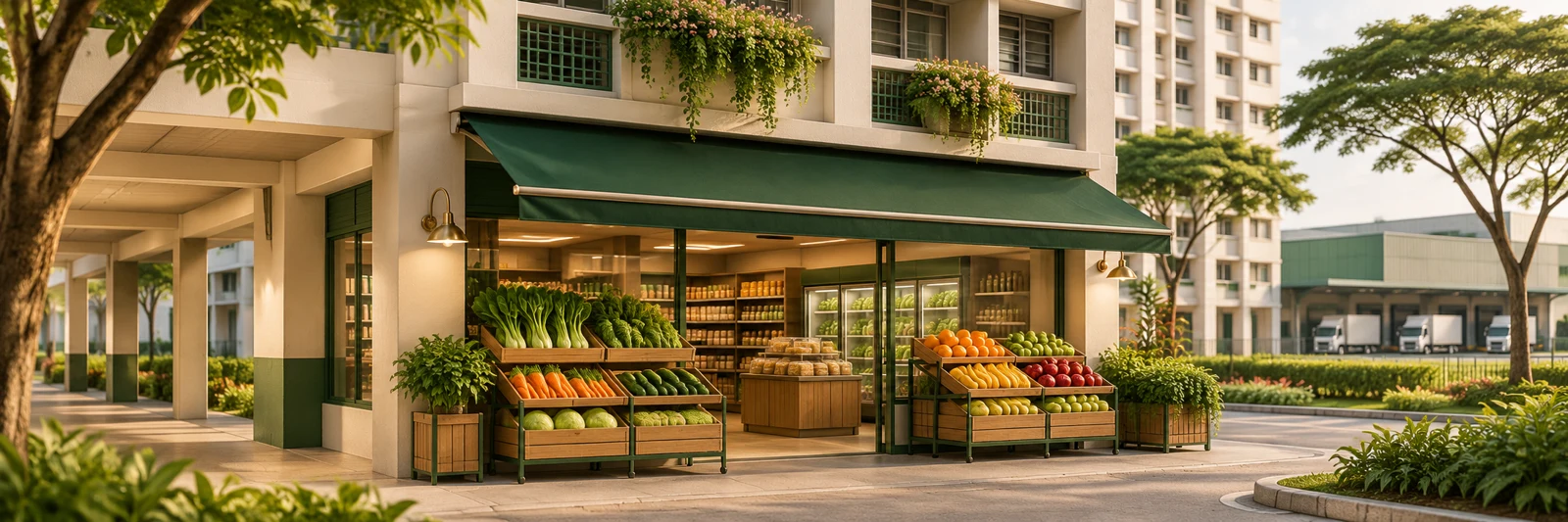
A supermarket business built around neighbourhood shopping
Sheng Siong operates supermarkets close to Singapore’s residential communities, with fresh food and everyday groceries bringing customers back regularly. Direct sourcing, private-label products and disciplined purchasing have helped it build a profitable business in a competitive market.
The company had 92 Singapore supermarkets at September 2026, compared with 69 at the end of 2023. Our forecasts assume 106 by FY2031. With modest growth in sales at established stores, new openings are expected to account for most of the increase in revenue.
A larger network does not automatically mean faster profit growth
Higher wages, rents and the cost of bringing new stores up to normal trading levels make it harder to turn additional sales into earnings. In the September 2026 quarter, revenue rose 6.2%, while comparable-store sales fell 0.5% and attributable profit grew 1.9%.
We forecast revenue rising from S$1.71 billion in FY2026 to S$2.16 billion in FY2031. Attributable profit grows more slowly, from S$159.6 million to S$174.4 million, as operating costs absorb much of the benefit.
Sungei Kadut brings capacity and a demanding investment period
The planned integrated headquarters and distribution centre is designed to support more than 120 supermarkets. The S$520 million commitment includes rent over a 33-year land lease; it is not all upfront construction spending.
Our forecasts assume the facility begins operating around FY2030. Depreciation, commissioning expenses and overlapping costs during the transition will arrive before the additional capacity is fully used. We expect EBIT margin to fall from 11.2% in FY2026 to 9.8% in FY2031, with scope for a later recovery as more stores use the facility.
Our forecasts
| Metric | FY2026 estimate | FY2031 estimate |
|---|---|---|
| Singapore supermarkets | 92 | 106 |
| Revenue (S$m) | 1,710.9 | 2,159.6 |
| Attributable profit (S$m) | 159.6 | 174.4 |
| EBIT margin | 11.2% | 9.8% |
Source: Evermore Research report released on 6 November 2026. Financial years end in December. Both columns contain analyst estimates.
Cash reserves help, but returns still matter
Sheng Siong held S$388.9 million of cash at September 2026 and had no conventional bank borrowings. That provides room to invest and maintain dividends, although our forecasts show free cash flow tightening during construction and modest temporary borrowing in FY2029. That borrowing is an analyst forecast, rather than a company funding plan.
The main risks are weaker new-store economics, rising operating costs, construction overruns and slower improvements in distribution efficiency. A substantial portion of the project’s estimated value depends on cash generated well into the future.
Valuation and recommendation
The report initiates coverage with a Buy recommendation and a 12-month target of S$2.97. Against the S$2.41 reference price on 5 November 2026, that represents 23.2% potential capital upside and approximately 26.3% expected total return including forecast dividends.
The discounted cash-flow valuation uses a 6.98% weighted average cost of capital and 2.0% terminal growth. The full report explains the forecasts, lease treatment, project economics and valuation sensitivities.
Read the full report
The 25-page initiation includes the detailed analysis, forecasts, valuation and research disclosures.
Download the report (PDF)Sources and disclosures
This page summarises Evermore Research’s Sheng Siong Group report released on 6 November 2026. Sources are documented in the PDF; research disclosures appear on pages 24–25.
Neither Evermore Research nor the author holds shares in Sheng Siong Group.
Intended for US readers only. General, impersonal research. Forecasts and valuation targets are estimates and may change. Read the full report for the assumptions and risks.